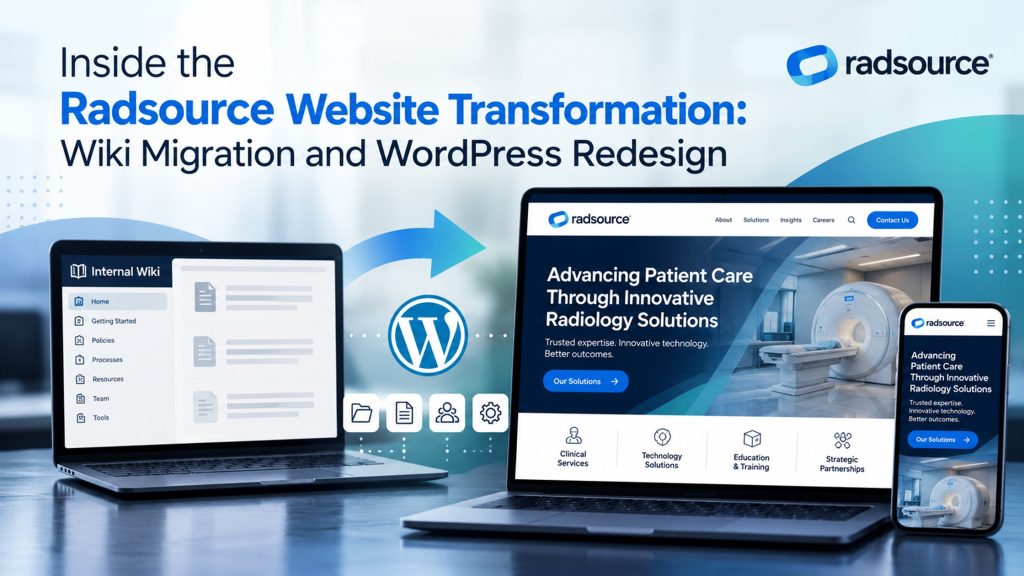
Two Digital Experiences, One Bigger Vision
Organizations often focus heavily on their public websites—and understandably so. A website is frequently the first digital interaction a potential customer, partner, or stakeholder has with a business. But what happens behind the scenes matters just as much. Internal knowledge platforms help teams organize information, access important resources, and keep knowledge available across the organization. When those systems become difficult to navigate or maintain, productivity can suffer.
For Radsource, the transformation therefore had two sides:
Internally, the goal was to migrate wiki content into a more flexible WordPress environment.
Externally, the objective was to redesign the public website and establish a modern experience that better supported the organization’s digital presence.
Instead of treating these as unrelated projects, the transformation created an opportunity to modernize the broader digital ecosystem.
The Challenge: Moving Beyond a Traditional Internal Wiki
Internal wikis can become incredibly valuable over time. They accumulate processes, reference materials, institutional knowledge, documentation, and resources that employees depend on. But as the amount of information grows, older platforms can become harder to maintain. Content management may become cumbersome. Navigation can feel outdated. Finding information may take longer than it should. Making structural or design changes can also require more effort. Migrating such a system isn’t simply a matter of copying pages from one platform to another. The real challenge is preserving the value of the existing knowledge while creating a better environment for managing it going forward.That made WordPress a compelling foundation for the next chapter.
From Wiki to WordPress: Creating a More Flexible Knowledge Platform
Moving Radsource’s internal wiki to WordPress opened the door to a more manageable and adaptable content experience. WordPress provides a familiar content management framework that can make publishing, updating, categorizing, and organizing information considerably easier. But a successful migration requires careful planning. Existing content needs to be reviewed and transferred without losing important information. Navigation needs to make sense in the new environment. Content relationships, categories, links, media, and page structures all need attention.
The goal isn’t simply:
“Move everything to WordPress.”
It’s:
“Make everything work better once it gets there.”
That distinction is critical.
By approaching migration as an opportunity to improve the underlying content experience, an organization can turn an aging knowledge repository into a platform that’s easier to maintain and better prepared to evolve.
A Public Website Ready for a New Chapter
While the internal platform focused on knowledge accessibility, Radsource’s public website had a different job: it needed to communicate. A successful public website should quickly help visitors understand who an organization is, what it offers, and where they should go next.
As part of the Radsource website transformation, the redesign focused on creating a stronger digital experience through improved design, navigation, content hierarchy, responsiveness, and performance.
The redesign wasn’t just about giving Radsource a fresh visual identity online. It was about creating a website experience built around today’s users. That means clear information architecture, intuitive navigation, purposeful layouts, mobile-friendly experiences, and calls to action that guide visitors instead of leaving them searching for answers.
More Than a Fresh Coat of Paint
One of the easiest mistakes in website redesign is focusing exclusively on appearance.
Modern colors? Great.
Better graphics? Excellent.
New layouts? Absolutely.
But a meaningful redesign goes deeper.
The most effective websites balance design, usability, content, performance, and scalability.
For Radsource, the redesign represented an opportunity to rethink how visitors interact with the website from the moment they arrive.
Every page has a purpose. Every section should help communicate something important. And every interaction should make the visitor’s journey easier.
The finished experience isn’t simply supposed to look modern.
It needs to feel modern.
WordPress as the Foundation for Growth
One of WordPress’s biggest strengths is flexibility. Organizations aren’t locked into a static website that becomes increasingly difficult to change. A well-built WordPress environment can evolve as business requirements evolve.
New pages can be introduced. Existing content can be updated. Features can be expanded. Marketing initiatives can be supported without rebuilding the entire digital presence every time priorities change.
For Radsource, that flexibility was particularly valuable because WordPress could support both sides of the transformation: internal knowledge management and external digital communication.
Different audiences. Different objectives. One flexible technology ecosystem.
Building for the People Who Actually Use It
Technology projects can easily become centered around platforms, plugins, databases, templates, and features.
But ultimately, digital transformation is about people.
For an internal knowledge platform, the key question is:
Can employees find and manage the information they need efficiently?
For a public website, it’s:
Can visitors quickly understand the organization and find what they’re looking for?
Keeping these questions at the center of the project helps turn technical improvements into meaningful user experiences.
That’s where the Radsource transformation becomes especially interesting. The project wasn’t simply replacing technology—it was improving how different groups interact with information.
One Transformation, Multiple Benefits
Bringing an internal wiki into WordPress while simultaneously modernizing a public-facing website can create advantages far beyond aesthetics.
A modernized ecosystem can offer:
- Simpler content management for teams responsible for maintaining information.
- Better organization of internal resources and knowledge.
- Improved user experience across desktop and mobile devices.
- Greater flexibility for future content and functionality.
- A stronger public presence that better reflects the organization.
- A scalable foundation capable of adapting as requirements change.
Most importantly, modernization reduces friction.
Employees shouldn’t have to fight their tools to access knowledge, and visitors shouldn’t have to work hard to understand a website.
Good technology gets out of the way and lets people accomplish what they came to do.
The Power of Modernizing from the Inside Out
The Radsource project demonstrates an important lesson about digital transformation: your internal and external digital experiences are both part of the bigger picture.
A beautifully redesigned public website can strengthen an organization’s external presence. A well-organized internal knowledge platform can help strengthen the way information flows behind the scenes.
The Radsource website transformation brought these two priorities together, creating a more powerful digital foundation that supports the organization from the inside out.
The move from an internal wiki to WordPress brought existing knowledge into a more flexible environment. At the same time, the public website redesign created a fresh, modern experience built to better serve today’s visitors.
Together, these initiatives represent more than a migration and redesign. They represent progress.
Looking Forward
The best website projects aren’t designed only for launch day. They’re built for what comes next.
As Radsource website transformation continues to evolve, its digital platforms now have a stronger foundation for new content, changing requirements, new initiatives, and future opportunities.
That’s ultimately what makes a successful digital transformation: not simply replacing what existed yesterday, but creating something capable of supporting tomorrow.
From internal knowledge to the public web experience, the Radsource transformation shows what can happen when thoughtful migration, modern design, and flexible technology come together.