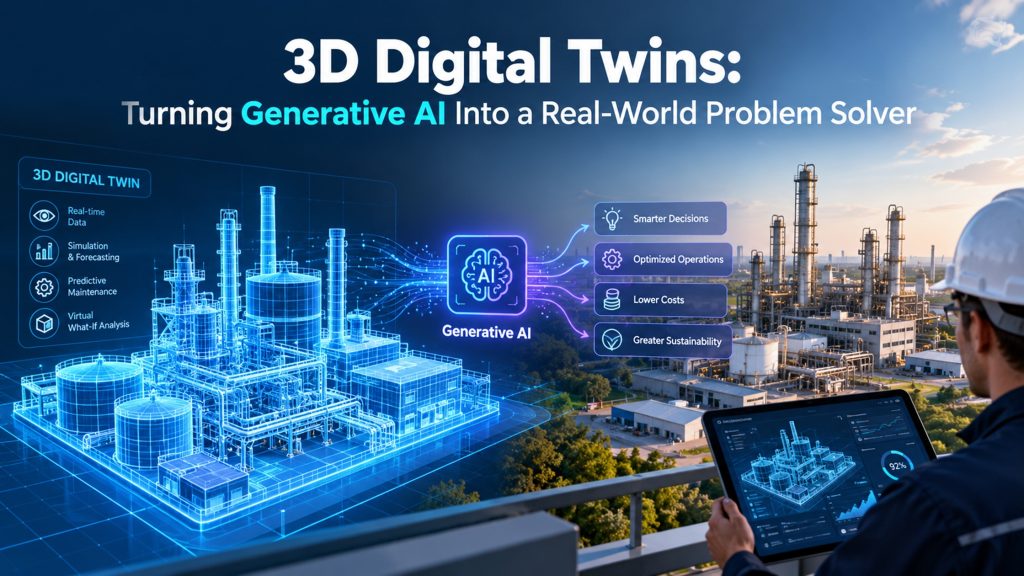
Generative AI has transformed how businesses create content, analyze information, automate workflows, and interact with customers. Yet, AI systems often work primarily with digital information—text, images, documents, and datasets. To solve complex physical-world problems, AI needs more than data. It needs context, spatial understanding, and an accurate representation of the environment it is working with. This is where 3D digital twins are becoming increasingly important.
A 3D digital twin is a virtual representation of a physical object, facility, machine, infrastructure system, or even an entire environment. When combined with generative AI, it can create a powerful connection between digital intelligence and the real world.
Understanding Generative AI
Generative AI is revolutionizing the way we interact with technology. At its core, it refers to algorithms that can create content autonomously. This includes images, text, music, and even 3D models. By analyzing vast datasets, generative AI learns patterns and styles that allow it to produce new and unique outputs.
One of the most exciting aspects of generative AI is its ability to mimic human creativity. It goes beyond traditional programming by generating solutions or designs without explicit instructions. Instead of simply following a set path, these systems explore possibilities in ways that feel intuitive.
The technology relies heavily on neural networks and deep learning techniques. These methods enable machines to process information similarly to how humans learn from experience. As they train on diverse data sources, they improve their output quality over time.
As such advancements continue, industries are beginning to grasp the potential applications for generative AI in fields like architecture and product design. The synergy between this technology and other digital innovations paves the way for groundbreaking developments in various sectors.
Applications of 3D Digital Twins
3D Digital Twins are transforming various industries by providing a virtual replica of physical assets. These realistic simulations allow for enhanced monitoring and predictive maintenance in sectors like manufacturing and construction. By analyzing data from sensors embedded in machinery, companies can anticipate failures before they occur, reducing downtime and saving costs.
In healthcare, 3D Digital Twins play a crucial role in personalized medicine. They enable clinicians to create tailored treatment plans based on an individual’s unique anatomy and health conditions. This technology has the potential to revolutionize how surgeries are planned and executed, making them safer and more efficient.
Urban planning is another area where 3D Digital Twins shine. City planners use these models to visualize infrastructure changes or new developments within existing environments. This helps stakeholders understand the impact of urbanization on traffic flow, public spaces, and resource allocation.
Moreover, the entertainment industry benefits significantly through 3D digital replicas for character modeling or set design in films and video games. Artists can manipulate these virtual entities effortlessly, leading to richer storytelling experiences that captivate audiences worldwide.
Creating Real-World Solutions
3D digital twins are transforming industries by providing a virtual replica of physical entities. This technology allows for real-time monitoring and analysis, enabling organizations to make informed decisions. With accurate data at their fingertips, businesses can optimize processes in ways once thought impossible.
For example, in manufacturing, 3D digital twins help streamline production lines. By simulating different scenarios within the twin’s environment, companies can identify bottlenecks before they occur. This proactive approach not only saves time but also reduces costs significantly.
In urban planning, city officials use 3D digital twins to visualize infrastructure and environmental impacts. These models allow for better resource allocation and smart city initiatives that enhance residents’ quality of life. They enable planners to foresee potential issues and address them proactively.
Healthcare is another field benefiting from this innovation. Hospitals create patient-specific 3D models to simulate surgeries or treatments tailored specifically for individuals. This personalized approach enhances outcomes and minimizes risks during procedures while improving overall patient care experiences.
Challenges and Limitations
While 3D digital twins are innovative, they face significant challenges. One major hurdle is data accuracy. If the information fed into these models is flawed or incomplete, the resulting twin won’t be a reliable representation of reality. This can lead to misguided decisions based on erroneous insights.
Another limitation lies in integration with existing systems. Many organizations use legacy technology that may not support advanced 3D modeling tools seamlessly. Bridging this gap often involves time-consuming and costly upgrades, which can hinder adoption.
Scalability also poses a problem for many companies venturing into digital twins. Creating a high-fidelity model of an entire facility or city requires substantial computational power and resources. As complexity increases, so do costs and technical requirements—making it less accessible for smaller firms.
There’s the challenge of user expertise. Not all teams have personnel trained to analyze or interpret data from these sophisticated models effectively. Without proper skills in place, potential benefits might remain untapped as users struggle to leverage 3D digital twins fully.
Innovations in Generative AI and 3D Modeling
The landscape of 3D digital twins is rapidly evolving, thanks to groundbreaking innovations in generative AI. These technologies are reshaping how we create and manipulate 3D models. The synergy between the two fields allows for more efficient design processes and greater customization than ever before.
Generative AI leverages vast amounts of data to produce optimized designs that meet specific criteria. This means industries can now generate multiple versions of a digital twin with different parameters, all tailored to solve unique challenges.
Moreover, advancements in machine learning algorithms enable real-time updates to these models based on current data inputs. As conditions change—such as environmental factors or machinery performance—the digital twin reflects those changes instantly, providing stakeholders with accurate insights.
These innovations open up new possibilities across various sectors including manufacturing, healthcare, and urban planning. By utilizing generative AI alongside 3D modeling techniques, organizations can enhance decision-making processes and drive efficiency.
As this technology continues to develop at an exceptional pace, it’s clear that the future holds immense potential for creating smarter solutions through 3D digital twins. The blend of creativity and technical prowess will likely redefine problem-solving approaches globally.