Artificial intelligence is rapidly moving from general-purpose assistance to industry-focused execution. While horizontal AI tools once dominated the market with broad capabilities like content generation, coding support, and workflow automation, businesses in 2026 are increasingly turning toward vertical AI solutions built for specific industries and operational needs. This shift is redefining how companies automate tasks, improve decision-making, and deliver customer experiences at scale. Vertical AI agents are designed with deep domain expertise, industry-specific data, and specialized workflows that allow them to perform highly targeted tasks with greater accuracy and efficiency. From healthcare and finance to retail and logistics, these intelligent systems are helping organizations solve complex challenges that generic AI copilots often struggle to handle. Instead of acting as broad assistants, vertical AI agents function more like expert digital employees trained for a single business environment.
As enterprises demand more reliable automation, compliance awareness, and operational precision, the limitations of horizontal AI are becoming increasingly visible. Businesses no longer want AI that only assists — they want AI that understands their industry, adapts to their processes, and produces measurable outcomes.
In this blog, we’ll explore the key differences between vertical and horizontal AI, why businesses are making the transition, and how this evolution is reshaping the future of business automation in 2026 and beyond.
Definition and Differences between Vertical and Horizontal AI
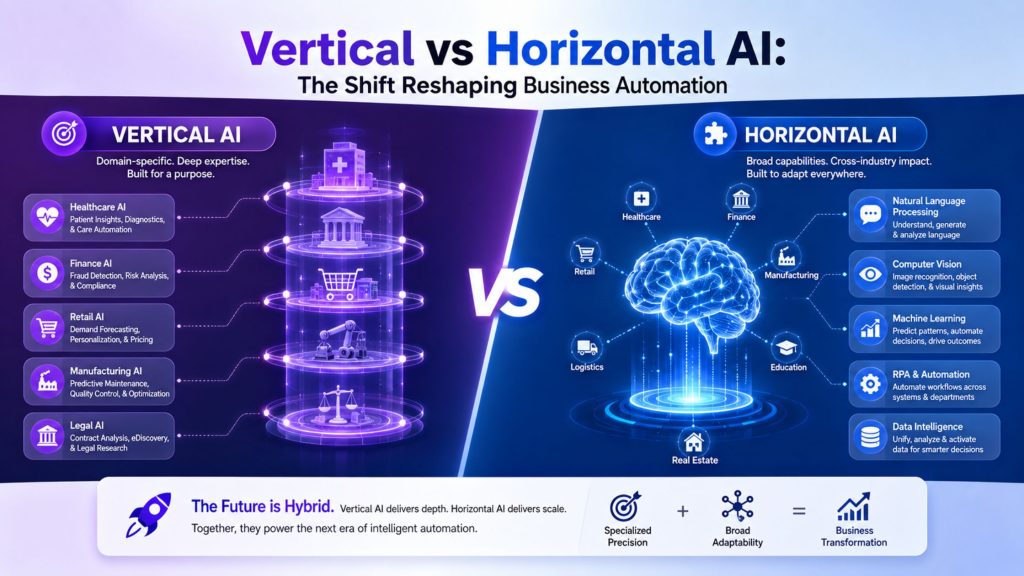
Vertical AI focuses on specific industries or niches, offering tailored solutions. It understands the unique challenges and requirements of sectors like healthcare, finance, or manufacturing. By honing in on a particular area, these systems can deliver highly specialized insights and functionalities.
On the other hand, Horizontal AI is more generalized. It aims to provide broad applications across various fields. This type of AI promotes versatility by serving multiple industries with common tools and technologies.
The fundamental difference lies in specialization versus generalization. Vertical AI excels at deep learning within its domain while Horizontal AI offers adaptability to diverse environments. Each approach has its strengths depending on business needs and objectives.
Choosing between them requires careful consideration of an organization’s goals and operational landscape.
What Truly Defines a Vertical AI Agent?
Vertical AI agents focus on specific industries or sectors. They are designed to tackle unique challenges within those areas. This specialization allows them to deliver tailored solutions that general-purpose AIs often miss.
These agents excel at analyzing domain-specific data. For example, in healthcare, a vertical AI can sift through patient records and provide insights that enhance diagnosis accuracy. In finance, it can detect fraudulent transactions with high precision.
The integration of industry knowledge sets vertical AIs apart from their horizontal counterparts. They adapt quickly to nuances in regulations and market trends. This agility is crucial for businesses aiming for competitive advantages.
Moreover, vertical AIs foster deeper user engagement by addressing unique pain points effectively. Their ability to streamline operations can lead directly to increased productivity and efficiency within targeted sectors.
Why Vertical AI Agents Are Winning in 2026
Vertical AI agents are increasingly dominating the landscape in 2026. Their ability to specialize within niche markets allows them to address specific business needs with remarkable precision.
These tailored solutions enhance productivity and streamline operations. Industries such as healthcare, finance, and manufacturing benefit from vertical AI’s focused capabilities. For instance, an AI agent designed for medical diagnostics can analyze data faster than general-purpose systems.
Moreover, companies appreciate the quicker implementation times associated with vertical AI agents. They often integrate more seamlessly into existing workflows without requiring extensive retraining of personnel.
The competitive edge gained through these specialized tools is hard to ignore. Organizations leveraging vertical AI are witnessing improved outcomes and higher customer satisfaction rates as a result of these advancements in technology.
The Advantages of Horizontal AI in Business Automation
Horizontal AI offers remarkable versatility across various sectors. Its ability to integrate seamlessly with existing systems allows businesses to enhance productivity without overhauling their infrastructure.
This adaptability means that organizations can implement solutions tailored to diverse functions, from finance to human resources. The cross-industry applicability of Horizontal AI fosters innovation while reducing costs associated with specialized software development.
Another advantage is its scalability. As a business grows, Horizontal AI can easily adjust and expand alongside it, ensuring consistent performance and functionality in an evolving market landscape.
Moreover, the data-driven insights provided by Horizontal AI contribute significantly to strategic decision-making. Businesses gain access to comprehensive analytics that inform actions and optimize processes across departments.
With easy integration into workflows and a focus on broader applications, Horizontal AI empowers companies seeking efficient automation strategies in today’s competitive environment.
Challenges of Implementing Horizontal AI
Implementing Horizontal AI poses several significant challenges for businesses. First, integrating such systems into existing infrastructure can be complicated. Legacy technology often lacks compatibility with modern AI solutions.
Data quality is another hurdle. Horizontal AI requires vast amounts of diverse data to function effectively. If the input data is inconsistent or flawed, the outcomes may not meet expectations.
Moreover, talent shortages can hinder progress. Finding skilled personnel who understand both AI and industry-specific requirements isn’t easy.
Additionally, organizations face resistance to change from employees accustomed to traditional processes. This cultural barrier can slow down adoption rates significantly.
Privacy concerns arise when handling sensitive information across different sectors. Companies must navigate complex regulations while seeking innovative applications of horizontal solutions in their operations.
Conclusion: The Future of Business Automation with AI
The landscape of business automation is rapidly evolving, driven by advancements in artificial intelligence. As companies increasingly rely on AI to streamline processes, the debate between vertical and horizontal AI intensifies. Vertical AI agents specialize in specific industries, delivering tailored solutions that enhance performance and efficiency. Their rise signals a shift towards more focused applications of technology.
While horizontal AI offers a broader range of functionalities across different sectors, it often lacks the depth needed for specialized tasks. Businesses must weigh these options carefully as they aim to optimize operations and stay competitive.
As we move further into 2026 and beyond, understanding these distinctions will be crucial for organizations looking to harness the power of AI effectively. The future promises exciting possibilities; those who embrace vertical solutions may find themselves leading the charge in their respective fields while still recognizing where horizontal capabilities can complement their strategies. Embracing both approaches strategically could very well define success in an automated world that leans heavily on intelligent solutions.